Self-Rebuild Challenge: A 60-Day Personal Development Framework for Internal Alignment
Understanding what the challenge is, why it exists, how it compares, and whether it's right for you.

TL;DR Executive Summary
The Self-Rebuild Challenge is a 60-day framework (20–30 min/day) built on the idea that most people don't fail from lack of knowledge — they fail from misalignment between what they think, say, write, and do (the "Four Worlds"). It's not a motivation program, has no coaching, no upsells, and no premium tiers — one complete framework, self-guided. It's best for people who already know what to do but can't stay consistent; it's not the right fit if you want a single-habit fix, a productivity system, or purpose-discovery — those are better solved elsewhere.
If you've just come across the Self-Rebuild Challenge, you probably have questions — especially if you've tried other personal development frameworks and still feel inconsistent.
That's good. You shouldn't commit to something simply because it sounds inspiring. You should understand what it is, why it exists, and whether it's right for you. This article walks through all of it — what the challenge is, why it was built, how it compares to other personal development programs, and what you can (and can't) expect from it.
What Is the Self-Rebuild Challenge?
The Self-Rebuild Challenge is a structured 60-day journey designed to help you rebuild your life from the inside out.
It isn't about becoming someone new. It's about bringing consistency to the person you already are. Many people know what they should do but struggle to do it consistently. This challenge focuses on closing that gap.
Why Was It Created?
Most personal development focuses on adding more. More motivation. More habits. More goals. More information. Yet many people still feel stuck.
The Self-Rebuild Challenge was created from a different observation: the problem often isn't a lack of knowledge. It's a lack of alignment.
What Does "Self-Rebuild" Actually Mean?
Think about a building. If the foundation develops cracks, repainting the walls won't solve the problem. The structure has to be rebuilt.
The same applies to us. Sometimes the issue isn't your job, your routine, or your environment. Sometimes your internal structure needs rebuilding. That's what this challenge is about.
Who Is This Challenge For?
This challenge is for people who want to rebuild their life or restart their life with more consistency — not another burst of personal growth or self-improvement content that fades in a week.
Specifically, it's for people who:
- Feel stuck despite trying hard
- Start things but don't finish them
- Feel capable of more
- Keep restarting
- Want lasting change instead of temporary motivation
- Want to understand themselves better
Is This Another Motivational Program?
No. Motivation is temporary. This challenge is built around structure, awareness, reflection, and consistent action — discipline over motivation. Instead of asking "How do I stay motivated?" it asks "How do I become aligned?"
What Makes This Different?
Most systems try to change your behavior first. This challenge begins with your internal architecture. Instead of forcing discipline, it helps you understand why consistency breaks in the first place — and rebuilds your daily habits from that understanding, not around it.
What Problem Does It Solve?
Many people experience the same pattern: they think differently than they speak. They speak differently than they act. They make plans they never follow. Eventually they begin questioning themselves.
The challenge helps reduce these internal contradictions.
The Four Worlds: Why You Feel Misaligned
According to this framework, every person lives in four worlds simultaneously:
When these worlds move in different directions, progress becomes difficult. When they move together, life becomes clearer. Imagine trying to drive a car while each wheel points in a different direction. No matter how powerful the engine is, the journey becomes difficult. The Four Worlds work the same way. Alignment creates momentum. Misalignment creates friction.

Diagram of the Four Worlds: Thinking, Speaking, Writing, Acting
- The Thinking World — what you believe.
- The Speaking World — what you communicate.
- The Writing World — what you record, plan, and commit to.
- The Acting World — what you actually do.
Execution & Practical Questions
Do I Need to Read All the Books First? No. The challenge guides you step by step. The books provide deeper understanding and context as you progress.
How Long Is the Challenge — and How Much Time Does It Take? The program runs for 60 days. Each day builds on the previous one. The goal isn't speed — the goal is lasting change. It takes around 20 to 30 minutes each day. Consistency matters more than intensity.
Is This Based on Psychology or Spirituality? The Self-Rebuild Challenge is a practical framework centered on observation, reflection, and action. It encourages you to examine your own experiences rather than asking you to adopt a belief system.
Will This Solve All My Problems? No program can promise that. What it can provide is a structured process for understanding yourself better, identifying internal inconsistencies, and building more intentional habits.
What If I Miss a Day? Continue where you left off. The purpose is progress, not perfection.
What If I Don't Know My Purpose? You don't need to. The challenge doesn't begin with finding your life's purpose. It begins with understanding your current patterns. Purpose often becomes clearer as alignment improves.
Is This About Productivity? Not exclusively. Productivity is one possible outcome. The deeper focus is on becoming more consistent in how you think, communicate, plan, and act.
What Kind of Results Can I Expect?
Participants may experience:
- Greater mental clarity
- Better self-awareness
- Improved consistency
- Stronger decision-making
- Reduced internal conflict
- More confidence in taking action
- Rebuilt self-trust, one small win at a time
Why Do I Keep Starting Over & What Happens After 60 Days?
Many people assume they lack discipline. Sometimes the real issue is that different parts of them are working toward different outcomes. When your thoughts, words, plans, and actions stop supporting one another, every new beginning feels like another restart. The challenge is designed to help bring those parts back into alignment.
Is There a Community? Yes. The challenge is intended to be experienced alongside others who are committed to rebuilding themselves. The goal isn't competition — it's shared growth through consistent practice.
What Happens After 60 Days? The challenge doesn't end with Day 60. By then, you'll have developed a framework that you can continue using to evaluate decisions, relationships, habits, and future goals.
Why Should I Trust This Framework? You don't need to. You only need to be willing to test it. The Self-Rebuild Challenge doesn't ask for belief. It asks for participation. Because the value of any framework isn't determined by how convincing it sounds — it's determined by what changes after you apply it.
Why Choose the Self-Rebuild Challenge Over Other Personal Development Programs?
There are thousands of books, courses, workshops, and coaching programs promising transformation. Most of them work — for some people, in some situations.
The better question isn't "Which one is the best?" It's "What problem does each one solve?"
The Self-Rebuild Challenge was created to solve a specific problem: why do people know what to do, yet consistently fail to do it? Instead of focusing on external success or motivation, it focuses on aligning your internal system.
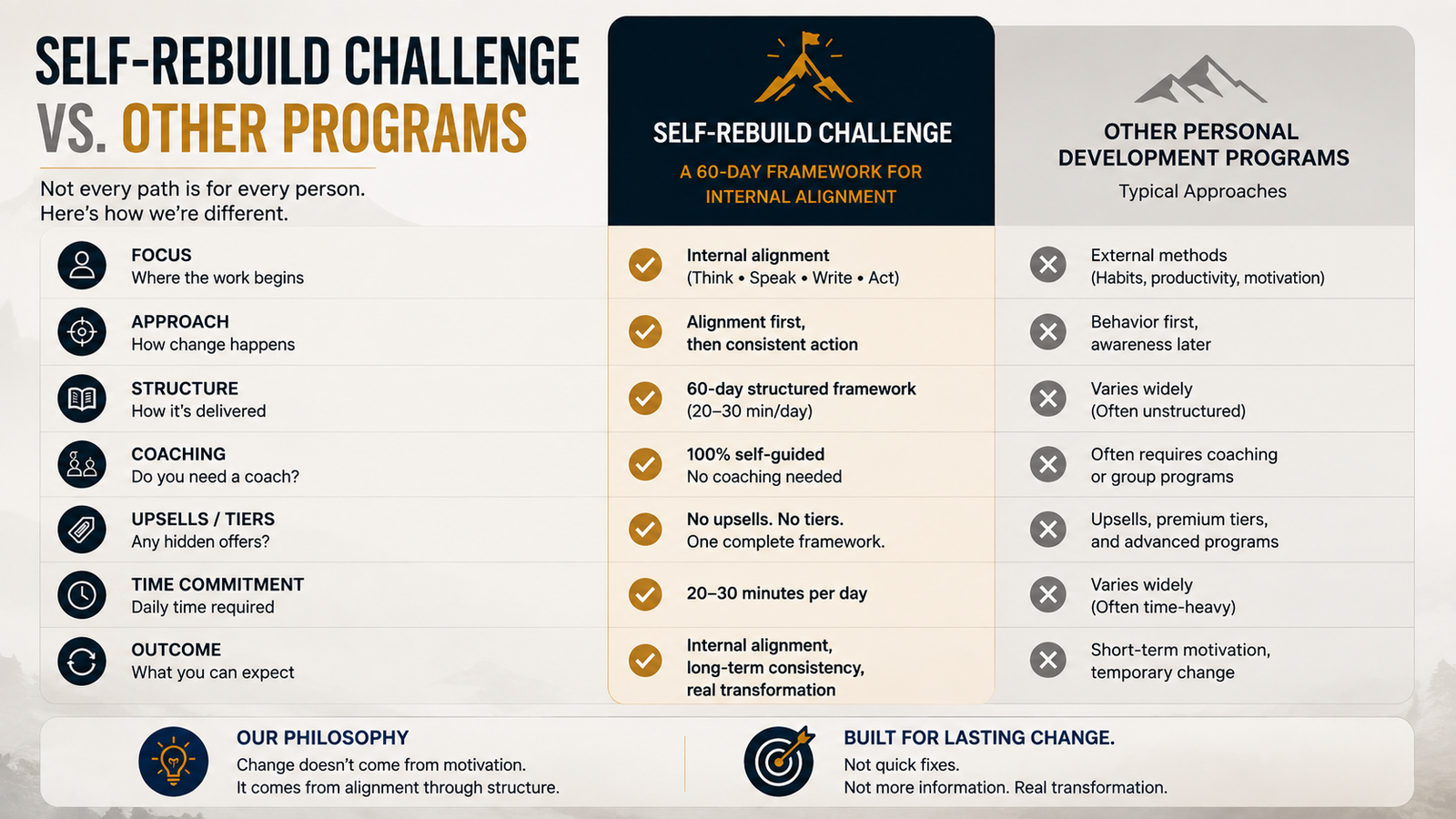
Comparison chart: Self-Rebuild Challenge vs. other personal development frameworks
| Framework | Primary Focus | Starts With | Main Goal | Best Suited For |
|---|---|---|---|---|
| Self-Rebuild Challenge | Internal alignment | Self-observation | Align thoughts, words, writing & actions | People who know what to do but can't stay consistent |
| Habit programs (Atomic Habits style) | Habit formation | Small behavior changes | Build better habits | People who know which habit they want to build |
| Character & principles (7 Habits style) | Character & effectiveness | Principles | Personal effectiveness | People who want a broad effectiveness philosophy |
| Productivity systems (GTD style) | Productivity | Task management | Reduce overwhelm | People struggling with task & time management |
| Purpose discovery (Ikigai style) | Purpose | Meaning | Discover purpose | People searching for direction, not execution |
| Morning routines (5 AM Club style) | Morning routine | Daily routine | Discipline | People wanting specific daily structure |
| Coaching programs | Goal achievement | Desired outcome | Reach goals | People wanting ongoing 1:1 guidance |
Core Distinctions of the Framework
It Doesn't Start With Goals: Many programs begin by asking "What do you want?" The Self-Rebuild Challenge asks something different: "Who is making your decisions today?" Because unclear goals are often symptoms, not the root problem.
It Doesn't Assume Motivation Is Missing: Most systems try to increase motivation. This framework asks: "Why do motivated people still procrastinate?" The answer isn't always motivation. Sometimes it's contradiction.
It Doesn't Treat Habits as the Starting Point: Habits matter. But habits are expressions of deeper patterns. If those patterns remain conflicted, habits rarely last.
It Doesn't Promise a New Version of You: Growth comes from increasing consistency between thoughts, words, writing, and actions — not creating another identity.
It Doesn't Separate Thinking From Action: Knowledge without action creates frustration. Action without understanding creates repetition. The Self-Rebuild Challenge intentionally connects reflection with execution.
It Measures Alignment Instead of Achievement: Are your thoughts aligned with your actions? Do your words match your intentions? Are you living consistently with what you know?
Who Should Choose This Framework?
Choose the Self-Rebuild Challenge if:
- You keep restarting
- You know more than you apply
- You've read many self-help books but still feel inconsistent
- You're looking for understanding before optimization
- You want a practical framework rather than daily motivation
- You want a life reset built on values-based living, not just a new routine
Is There Any One-to-One Coaching Available?
No. That decision is intentional.
The Self-Rebuild Challenge is not built around a coach, a mentor, a guru, or a personality. It is built around a framework.
Many personal development programs eventually become dependent on the individual who created them. People begin following the person instead of understanding the principles. Progress often becomes tied to attending another session or buying another course.
The Self-Rebuild Challenge is different. It is designed to become unnecessary. The purpose of this framework is not to create followers — it is to help individuals become capable of observing, understanding, and rebuilding themselves independently.
This framework belongs equally to everyone who applies it. A fifteen-year-old student can apply it. A working professional can apply it. A business owner can apply it. A parent can apply it. A retired individual can apply it. If you are capable of observing yourself and taking action, the framework applies to you.
Is There Any Upsell or Cross-Sell in This Challenge?
No.
The Self-Rebuild Challenge is intentionally designed without upsells or cross-sells. Many programs are built as sales funnels — where the initial product is only the beginning of a series of upgrades, premium memberships, or hidden offers.
When you join the challenge, you receive the complete framework required to complete the journey. There are no locked modules waiting behind another payment. The challenge is complete by design.
Ready to Begin the 60-Day Journey?
You don't need a coach. You don't need to buy a second product later. You need 20 to 30 minutes a day, for 60 days, and a willingness to observe yourself honestly.

Siddharth Bharati
He is an author, entrepreneur, filmmaker, and systems thinker exploring the patterns that shape human behavior, creativity, and decision-making. His work brings together psychology, storytelling, design, and technology to develop practical frameworks that help people think more clearly and act with greater intention.